Showing posts with label Opinions. Show all posts

Thursday, April 12, 2007

# Yassar Halim

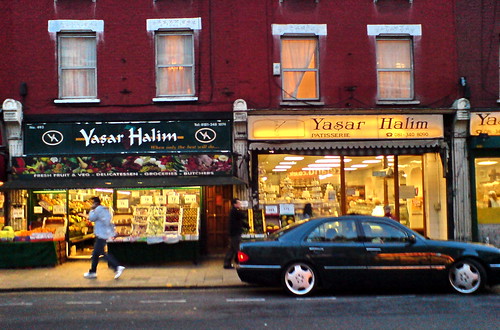
When we was having a stroll along Green Lanes, we passed by the groceries shop that we buy our foodstuff from - Yassar Halim. It sells normal groceries such as vegetables, meat, fruits, and it has its own bakery which makes a variety of cakes, breads and Turkish delicacies. I enjoy shopping there for its large diverse variety of vegetables available at cheap price, its fast and efficient service, as well as for the yummy cakes which I like to have as dessert. ^_^

The picture below shows the shop - the green one is where they sell their groceries, the white one is their bakery. Notice the extra bit of white shop on the right side? That's their extension of bakery.Yassar Halim

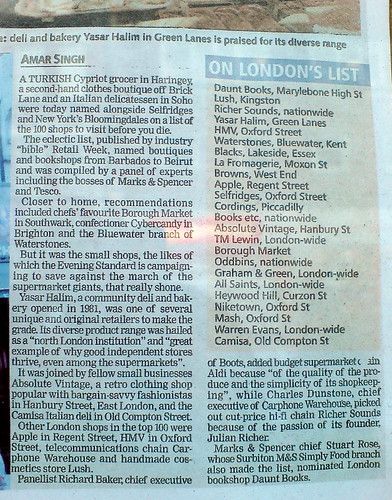
When we saw a newspaper cutting stuck to the front window of the shop...
We exclaimed a big "WOW"!!!

Yassar Halim, the very place we get our groceries, is considered as one of the "100 Shops to Visity Before You Die"!!! It ranked along with shops like NikeTown, HMV and Selfridges in Oxford Street, Apple store in Regent Street, etc... Boy, were we proud!

I like the idea of Evening Standard campaigning for small shops, against the giant supermarket chains which always kill all the local business with their megamarkets and unfair price wars. An obvious example would be Tesco, who has not only infiltrated most markets in UK, but expanding overseas into Asian markets. In my own small hometown Sungai Petani, the arrival of Tesco practically killed many of the small groceries stores - they simply couldn't compete with the low-price goods and large-variety-store of Tesco. It is quite sad actually, especially many of the storekeepers are either our friends or relatives.


I don't despise mega stores or chains, but it is some unfair competition to put small shops with giant stores side by side to compete. Well, free market allows the survival of the fittest, but it ignores the softer side of the society - the local culture, the community, the tradition.

For developing urban area with expanding population, it may be all right to put in new mega stores to cater to the growing population demand for a variety of goods and services. But for small towns with dwindling population and small local community, putting a mega store would just saturate the market and squeeze out all the small competitors. Free market competition argument is just not right here, due to the different market setting and sizes.


On the softer side, I personally think that local culture and tradition is important to preserve the local identity of the community. It is those small shops that we always have closer bonds with - we know the owners well, and we chit chat about our lives and take care of one another within the neighbourhood. Doing daily groceries is some enjoyment, having the chance to communicate with our neighbours and friends. In big mega chain stores, such kind of interaction is far less, the services might be more efficient and fast, but do we actually know, and care about those army of workers in the store? Or rather, we just hastily do our weekly shopping and speed off to cater to our much-more-important-things-to-do?

... Perhaps, my thinking has been more old-fashioned.
... Perhaps this is just the thinking of a small-town girl, who has yet to embraced the big-city mindset of not bothering about any other people, but solely minding your own business. But sometimes I do wonder, how do city people feel happy in such kind of environment?

Sunday, January 07, 2007

# Ponzi Scheme

(For general public reading, I will not use technical financial terms. I shall explain it in generic language so the explanation may be too simplistic to explain the complicated model.)

For my friends and family whom I care so much...

There is a kind of scheme with a very noble idea. A group of people pool their funds together and any member who needs the fund borrow from it. The borrower repay the loan with interest, and the members who lend get the interest. What is very attractive is the fund offers 20% interest rate return.

To ensure all members behave well and to safeguard the fund, there is a moderator who is very responsible and reliable. There is no documents, no regulations, no black-and-white in all transactions, because everything is done on "Trust". A very noble idea and a very wonderful way to help people and get help from others. In chinese language, it is called "作伙"

For friends who are considering to join a money scheme/ "mutual help fund pooling", think twice, or more than that.

  • Do you know who is borrowing the money?
  • Do you know who is contributing money?
  • Do you know what business the borrower is doing?
  • Do you know how the business is generating money?
  • Do you know how the money cashflow is moving about?
  • How the money is coming into the fund and how they are going out? Do the cash inflows and outflows balance? If not, who compensate for the difference?

Think about how much you can trust.
  • We can argue that everything is based on "Trust", and leave the fund management to a person who is "trustable", without proper license or any regulations controlling him.
  • But who are these people that you trust? And who are they trusting, is it beyond your control?
  • Can you trust so many strangers? I can trust my family, and the good friend I know, but do I trust the friend of the friend (of the friend...etc) that my friend trust?

Think about how workable and feasible is this scheme
  • You are promised 20% interest payback.
  • We must bear in mind that money will not appear from nowhere, so this 20% interest must come from somebody else money.
  • So where does that money come from? From the person who borrow the money from the fund, rite?
  • Think from the perspective of that person, if you are the borrower, would you want to borrow at 20% interest? or you would rather borrow from your own family, friends or even the bank which offer loan at <10%?
  • So will you actually borrow from the fund? If you think you won't, do you think others will want to do that?
  • If nobody borrow, where does your 20% interest come from? From new people who join the fund - let's use the new fund to pay the old member's profit. How long can this chain go on before it collapse?

Ok, let's assume there is really somebody who need the money so much that he is willing to borrow at 20% interest. He borrowed the money, do his whatever business.

Here are three scenarios:

1) His business is bad. He loses money, and face difficulty to repay the loan.
  • If he can't repay the loan, where does your 20% interest come from?
  • To sustain your return, the fund must get more new people to join, so that the new money can be used to pay your interest.
  • So now who pay the new people's interest? Do we hope that more people will take up loan, and hopefully (still) their business is good and they repay the loan? or do we hope more people will join so that our money can be repaid?
  • Do we have too many hopes? Do we just pass on our problem to "other people" and hope we are the earlier ones and lucky ones?

2) His business is ok. it is generating income, but he still faces many start-up costs and cannot repay in time.
  • If he temporarily can't repay the loan, you have to wait longer to get your interest. But how long can you wait?
  • What if you need the money now? Who pay for your money?
  • Again, since no money is coming into the fund, but money needs to go out to pay you. So, it needs more new people to join and sustain the fund.
  • How long can this go on? What if everyone demands to get their money back now, where does the money come from to pay all the 20% interest + capital amount?

3) His business is successful. He earn large profits. He repays his loan promptly as promised.
  • So now everyone is happy. The borrower earns profit and is so good-hearted to pay back high interest loan. Perhaps next time he would look for proper loan with lower interest from the banks, since his business is successful now.
  • The investors are happy too, we all get our 20% interest and we have helped people. Hurray.
  • But if this really works, don't you think ALL the financial transactions nowadays will be at this interest rate?
  • Don't you think this method will be so popular that everyone will follow, and everyone trust everyone? Everything based on promise and trust?
  • Lovely ideal world. It would be so wonderful if the real world is like that.

Think about the amount of risk you are taking by trusting so many people.
  • All it takes is a SINGLE person who cheats, or fails his obligation --> and everything falls apart.
  • All it takes is a simultaneous withrawal of all the members --> and the fund will collapse.
  • All it takes is a HIGH investment return (20%) --> to make our hearts tempted by greed, and believe as a small investor, we can earn 20% compared to the most successful investor in the world who earn <10%>
  • All it takes is a promise of TRUST --> to convince ourselves the world is perfect and the person whom the person we trust, is trustable.
  • All it takes is a hope that other people will pay for our profits --> to make us hopeful that we are the lucky ones and it is others who get cheated.

Think about how realistic the deal is
  • When a good deal seems too good to be true and interestingly not many people in the market is doing it to profit, think again.
  • Everything comes with a price. Money does not grow out of nowhere.

There are still A LOT of aspects to think about, which I leave you to think and explore. Explore the scheme from the perspective of all different people - the investors, the borrowers, the moderator. Is it workable?

Actually, there has been a lot of research and studies done about such scams, and all world's financial regulations forbid such practice because it eventually harms the investors. There is a name for such schemes, called "Ponzi scheme".

For further investigation and for history, some key words to google for are:
Ponzi scheme, high yield investment program, pyramid scheme, scam

Sunday, November 19, 2006

# A "freaky" game

I received a forwarded mail from my friend which goes like this...

"This is strange...can you figure it out?
Are you the 2% or 98% of the population?
Follow the instructions! NO PEEKING AHEAD!
There's no trick or surprise.

1) Think of a number from 1 to 10

2) Multiply that number by 9

3) If the number is a 2-digit number, add the digits together

4) Now subtract 5

5) Determine which letter in the alphabet corresponds to the number you ended up with
(example: 1=a, 2=b, 3=c,etc.)

6) Think of a country that starts with that letter.

7) Remember the last letter of the name of that country.

8) Think of the name of an animal that starts with that letter. Remember the last letter in the name of that animal.

9) Think of the name of a fruit that starts with that letter.

10) Are you thinking of a Kangaroo in Denmark eating an Orange?


I told you this was FREAKY!! If not, you're among the 2% of the population whose minds are different enough to think of something else. 98% of people will answer with kangaroos in Denmark when given this exercise. Keep this message going. This one is actually worth sending on to others. Forward it to people you know so they can find out if they are usual or unusual."

================================================

Okay... I don't find it THAT freaky. In fact, it is just a mind game that make use of people's general common knowledge and common vocabulary.

Mathematical Part
Step 1 to 4 are basically designed to make us come up with the number "4".
By multiplying any number with 9, and adding the digits together, we will get "9".
Look at the pattern of the multiplication table of 9 (from 1 to 10)
9, 18, 27, 36, 45, 54, 63, 72, 81, 90.
Notice that all of them have digits added up together as 9.

In fact, this does not only apply to number 1 - 10. It applies for any number as long as it is multiplied by 9.
For example, take 564 x 9 = 5076.
Adding the digits together gives 18.
Adding the digits again gives 9.

General Knowledge Part
As restricted by the first part, we will always start our country's name with "D"
Let's check the list of the countries of the whole world, starting with "D".
We have "Denmark", "Djibouti", "Dominica", Dominican Republic".

Now WHO would actually think of a country other than DENMARK? (except those who actually knows the other three very well or are residents in them)

So we are somewhat restricted to animal starting with "K" in our next question.
Now let's see what we have got here...
"Kangaroo", "Koala", "Kingfisher", "Kinkajou", "Kodiak Bear", "King vulture", "Killer whale", "Kirk's dik dik" (whatever this is), "Komodo dragon", "Kori bastard" (sorry, i mean Kori Bustard)...

People who are not zoologist would be only familiar with the more common "K" animal. On top of that, most people are taught during their primary education that "K for Kangaroo". I don't know about the statistics, but according to the person who started this forwarded mail, there should be 98% of the people taught this way. ;-P

Assuming we are the 98% which get "Kangaroo", we now need to find a fruit starting with "O". What we have here are:
"Orange", "Oregon grape", "Olive" (well now I just knew that olive is counted as food), "Osage orange" (still orange), "Oncoba", "Opuntia", "Osmanthus"...

Okay, now who would have thought of those fruits with exotic names instead of the simple orange? Especially we are bombarded with loads of information in our daily life such as "Orange is rich with Vitamin C", or the Sainsbury's "Buy 1 get 1 free Oranges", etc.

Conclusion
This mind game is not as freaky as claimed by the writer. He/she just apply certain restrictions to guide the readers towards the way he/she wants them to think. And he/she made use of the general knowledge of the public about names of places, animals and fruits, which is subject to the way education has shaped us.

Though the game is not freaky, it is scary to think about how big the impact of education have on human, especially the earlier education when we are young. That leads me to think of how some countries brainwash their citizens via education since young and shape the generation of today. Scaryyy...

Tuesday, November 14, 2006

# Blame the victim, not the predator

I am getting more and more aghast at the level of intelligence and concern for human rights in our beloved country. Not too long ago, there were arguments about whether some races were being marginalized, then the shocking news of murder of a mongolian model by our police forces, for god's sake!

Now there is this Penang Municipal Council saga - some pervert technician abuse the CCTV in the City Hall zooming on the thighs of women journalists during a council proceedings. As if this is not shameful enough, the Municipal Council President blamed the WOMEN for wearing "sexy" clothes that attract unwanted attention. Fucking hell, the women are wearing normal office attire. And so they change their wordings, saying their office attire is not LONG enough to cover their body parts below the knee.

It's the Skirt
Government Dress Code

50 years into independence and development, and our people seem to have not grasped the simple notion of human rights or justice. The principle seem to be "Blame the victim, protect the predator". Blame the women for wearing sexy clothes if they are raped. Blame the women if some sex perverts stalks on them. Blame the snatch thief victimes if they are carrying handbags. Blame the households who get robbed because they live lavishly.

This is the country I am going to serve in the future. This was the country I have had dreams to develop. This was the country I love and feel proud of so much. Where is the basic human values, where is the basic equality?

We need some changes in the country.


Wednesday, October 11, 2006

# Trust and Fear

Be afraid. Be very afraid.

North Korea has revealed that it has nuclear weapons. Terrorists are planning attacks at random places, random time. Natural disasters like hurricane/ earthquake are claiming thousands of lives. Even in micro scale, streets are no longer safe - snatch thiefs and rapists and killers are roaming in the streets...

A few weeks into lectures and studies in school, we learn, and re-learn about the basis of actuarial field - managing risk. We tried to identify risks, tried to understand people's fear, and tried to manage it. Uncertainty is the key word. Since older times, human has been fascinated by this nature of world - the only certain thing is that everything is always uncertain. Human has relentlessly tried to avoid uncertainty and reduce risks. Because we have FEAR.

Alongside with fear, we have TRUST. Trust is a wonderful nature of human being. By having trust, or in a higher extent, faith, human help one another. We build hopes and feel safe. Yet trust is such a fragile structure, hard to build and easy to destroy. In people's relation, we trust our family and friends. In financial world, we trust the insurance companies to manage our risks, or our banks to manage our finances. In socio-economic context, we trust (to some extent) our government, NGO, institutions and social bodies to provide stability and safety, and hopefully, equality.

Trust and Fear forms such a complex relationship. Balancing the two components are not easy. Reith Lectures series have delved deeply to try to understsand the interaction between these two natures - Onora O'neill (2002) with her lectures "A Question of Trust", Wole Soyinka (2004) with his lectures "Climates of Fear" have explored the effects of these emotions to human, and to a wider context, the society and world.

In older times, fear is easier to identify. It takes more tangible forms like natural disasters, wars, political problems, etc. The sources of fear stood broadly in public - we know who/what are the threats. That implies we have a chance to try to manage or do something about it. Also, we have a clearer concept of what is trustable/ reliable. We have clear definition of what is good and what is bad. And trust is a virtue which brings us forward in life.

Lately, various threats have taken into a more tacit form. Terrorist threats, for example, is so evasive, and yet so threatening. While last time people fear government/dictator who controlled the society/economy/politics, now we fear enemies who are underground, who might be anywhere, who might target anyone. It is not the states or institutions who are in charge, it seems like evil is on the loose. Remember the beheading of foreign soldiers in Iraq? How it casted a terror that the bigger ones are not always the one controlling the game. Within the same issue, look at how the campaign of anti-terrorism has eroded the trust in governments, or in the superpowers in the world.

In financial world, scandals after scandals are revealed. Companies were once in the talent race - recruiting the brightest and best. Yet Enron, Arthur Anderson and many other cases showed that talents alone could not guarantee success of companies. Trust is crucial, yet the strings of events have just done more harm than good to build people's trust in companies.

Also, old threats are resurging. Last time we feared the atomic bomb threat, we were worried about the arm races. Hence, human seek cooperative efforts via diplomatic agreements to keep them under control. In recent decades, the public perceptioin of fear moves to economical/ social threats more than these destructive threats. Somebody even forecasted that the future wars would be waged in terms of economics/ trades/ Internet/ etc. Yet, with North Korea's revelation about its nuclear power, suddenly we were back to the older times. The scary message conveyed, "You get bullied if you don't have WMD, you don't if you have."

Climates of fear is indeed encompassing us. With trust eroding in most aspects, human huddle in fear for the many risks and threats which seem to come from all directions. We really need to recognize that we have a crisis now - our fundamental values of goodness are being taken over by various threats.

By thrashing out fear after fear, I do not mean to say we are doomed. What I want to say is we still have hope, if we work for it. Until now, I still believe of purity and goodness as the fundamental state of human nature. It is just that human values have been polluted, and we need to clean them up. We need hope, we need faith, we need prayer, we need trust in each other. And we need each other. I hope the readers of this post could have a moment to ponder about the many issues that surround us today, and have a prayer for a better tomorrow. Have faith.

Monday, September 25, 2006

# Would all the cat-lovers please stand up?


During the SARS period, some people have the mistaken identity to think the ordinary stray cats are civet (thanks Mickell) cats (which is actually from the Rats family) and said that they spread SARS. A massive search and kill was launched in Singapore during that time and as many as 200 cats were terminated per day.

A blog friend of mine, Robin, a good-hearted animal lover, has teamed up with wish friends to provide temporary shelter for stray and abandoned cats, and making efforts either to track down their owners or find homes for them. Their work are time, energy and money-consuming, and needs support from all of us.

So if you know of anyone who wish to adopt a cat, a kitten, or who is willing to support such a cause in animal welfare and protection, please let Robin know.

No cash donations please. Food, kitty litter, toys, shampoo, cat adoption (subject to terms and conditions) and medicines are welcome. Please email Robin.

TO HELP, PLEASE GO TO THIS LINK

Thanks very much!

Tuesday, May 30, 2006

# Sipadan Damage

When I saw this news, I was dumbfounded. Gosh you can actually feel that sharp pain in the heart!! I actually can't stop my tears running down as I read on such irresponsible act.

I am too heavy-hearted right now to write a post about this yet another heart-breaking "human kills nature" story. It's about our beautiful Sipadan Island.

Here are the links... I really need to cool down before writing a post on this. These bastards have just overdone it! .... Damn them. (Pardon my language...)

Source from Wild Singapore

News in Yahoo

When did human ever learn??!!!

Tuesday, April 18, 2006

# Thoughts on Easter Island

(Photo from www.zeigermann.com)


This is a rather small post, for it is just a few scribbles of thoughts. Panda's comment in Stonehenge post about Rapa Nui reminded me about the downfall of the civilisation on the island, and the destruction of the Easter Island.

From the original lush green vegetation to the dry empty land, how could this happen? I am sure that the people are aware the depletion of the resources as the activities of deforestation goes on. I have heard before that the island is so small that one could stand on top of the mountain and see every corner of the island. But why have they not done anything to preserve the rescources before none was left?

As the resources continued to diminish, the dominoes effect comes in. The Islanders are trapped in a self-inflicted environmental collapse. With no trees, no boats can be built, hence they were cut off from the outside world. No more erection of the moai, hence the collapse of the belief systems, then social organisation. Then the meaningless destruction of the ahu among opposite clans, then war, then...

This looks familiar! Well, we do see them even in today's world! Look at how human consume the resources in the world, and we will know Easter Island has just provided a model of what-could-have-been. The set-up of the model is strikingly similar to the world we live in now - limited resources, unlimited wants. Throughout the years of human history, people have found ways and means to extract resrouces to sustain population growth. Yet, have we devised a system that actually conserve the environment and preserve the resources? Have we found a way of living that does not irreversibly damage our life support system?

In the Easter Island history, we saw the ugly nature of human of fighting for survival, and a scarier thought is that human has not even remorsed even until the final fatal end of the civilisation. If this is how human act, this would be a very scary reflection on today's society. In every aspect of our life, have we gone too beyond the turning point? Do we still carry out acts of destruction though we are well aware of the consequences? Do we ignore the warning signs and hope silently that the comeuppance will not fall on us, but on OTHER people?

Unfortunately, in most of the times, we do. And I am not speaking onlt in environmental terms. Major decisions in all fields - politics, economics, society, humanity... Have we not come upon some hauntingly familiar scenarios? Do we learn? Do we take different action?

Let's pray for a better tomorrow.

... ... ... ...

Okay, I should stop rambling before I go into a rattling mode.

Quote of the day:
"If we forgive God for his crime against us, which is to have made us finite creatures, he will forgive our crime against him, which is that we are finite creatures." - Simone Weil (1909-1943), French philosopher.