Monday, December 12, 2005

# Carshalton the Medieval Town

During our stay at David & Elizabeth place, Elizabeth took us for a walk to Carshalton, the medieval town nearby. We were lucky for such a sunny afternoon in London, especially after a few days of drizzle and mist. (Speaking of mist, I often wonder where has the famous smog in London gone? I have been here for 2 years, and yet have only seen 2 occasion of fog, not even smog, that covered London. Will the smog city show its true colour this year? I wonder...)

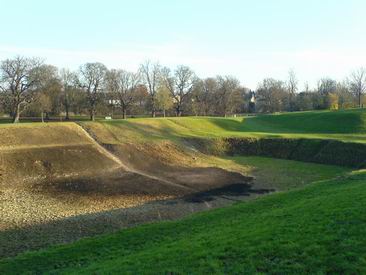
Anyway, back to our stroll to Carshalton. We walked past a few small parks on our way there, and one is particularly interesting. There is a football-field-sized pit dug right in the middle of the park, and left abandoned for many years. According to Elizabeth, there was a wealthy man who once owned this piece of land, and decided to build himself a mansion. The pit was dug for the foundation of the mansion, but before he managed to complete his mansion, he went bankcrupt. His land was sold, well, so was this pit. There was a dog running playfully INSIDE this pit when we passed by, but it was too deep down and all I had was this digital-zoom-only w800i. *grumble grumble* ^_^


The first sight that welcomed us at Carshalton was this canal that ran across the town. We were surprised to find seagulls in the canal, but Elizabeth explained that the place is quite near to the sea, so the seagulls love flocking to this place to have fun. Then she told us the stories about the White Cliffs of Dover which faces the French canal. It has been the main frontier of defence which has witnessed and survived many attacks and battles. When she spoke about 'seeing the white cliffs signifies home-coming for the warriors', there was this faraway look in her English eyes, and I somehow felt her burning patriotism deep in her heart.


We took a stroll along the streets in Carshalton, and I noticed that there are quite a number of antique shops here. Elizabeth told us that some of their furniture actually come from these shops, and people love to shop in such antique shops. You never know what you would get! (Yes indeed, another friend actually picked up a 100-year-old china plate for merely 5 pounds!)
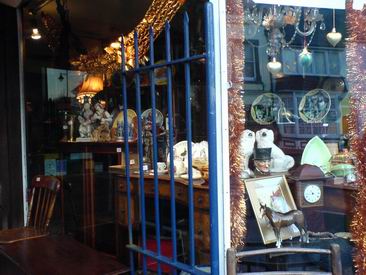
One of the antique shops in Carshalton


We walked along the canal, listening to the chirps of birds and quacks of ducks, the flapping sounds of wings, and the rustling sounds of leaves. After letting us savour the peaceful sight at the canal, Elizabeth led us to another corner of the town, and brought us to a large tree looming high before us. There was a plate on the ground that says, "This London plane tree as measured by the Forestry Commission in March 1964 is 123ft tall and has a girth of 20ft 11in at a height of 5ft above the ground level. It is the tallest London plane tree known in Britain, and is one of the very few trees of any kind to exceed both 120ft in height and 20ft in girth. The age of the tree is not known with accuracy, but is likely to exceed 200 years." We gaped at the tree which looked hauntingly old. Compared to us, it is old; but compared to the age of nature, this is nothing.


Walking and talking with Elizabeth is never a bore. She always has a lot of stories to tell, and a wealth of knowledge to share. At her age, she's still so fit and active, and is always full of ideas. She loves young people, and we love listening to old people's stories - so this trip is enjoyable for all of us. :-)
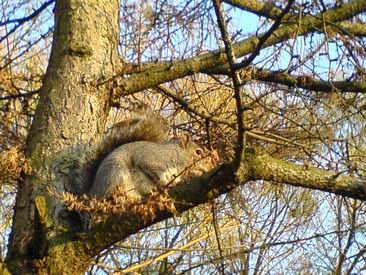
On our way back, we saw this squirrel camouflaged amidst the leaves, and Elizabeth started telling us about the red and grey squirrels, how the grey ones threatened the population of the red ones, and how the people tried to save the red ones. I haven't come across the red ones so far, and she said she herself has only managed to see some at the Lake District.

Well, that's it for the sunny afternoon, and we headed back to her house. Lovely stroll, with lovely people. I will keep this in my memory box. Thanks Elizabeth!

# Memories filled with love

It was a fruitful trip to Wallington last weekend. Huifang and I paid a visit to David and Elizabeth in Wallington, and we had a good feel of English life here.

Wallington is in Zone 5 of London, and it took 45 minutes of train journey from the Victoria station. When we arrived at the station, David was already waiting to pick us up. On our way to their home, I saw the christmas decoration on the street lights that resembled Lavender, and David told us that this area used to be planted full with lavender. Looking at the stretch of houses that we passed by, we were lost in our thoughts about the purple lavender and its beautiful fragance.

Walking into their house brought a similar feeling of many other houses I have been inside in UK. We were then told that this is a common structure of 1930's post-war architecture for middle class houses - 2 rooms on ground floor, 3 rooms on the first floor, narrow staircase, a garage and a backyard. Such design is common throughout England, as the government standardized the housing structure for easier town planning. No wonder most of the houses we saw are so similar!

Being in the house made me feel like an infant - everything in the house is so old! David and Elizabeth told us the stories of their furniture, inherited from different people, each having its own story. There was a three-legged tea table which has elephant head carvings on its legs, and a carving of an Indian god on the table top. There was a few other pieces of furniture like shelves and chairs that were inherited from Elizabeth's late aunt, each having an age more than 100 years!

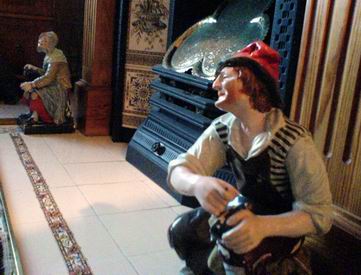
There is a fireplace in the living room, and I was intrigued by the two cute statues standing at each side of the fireplace. David excitedly told us about their origins - they got these two fellas (more than 100 years old, again!) quite some time ago, and never knew where to put them. They once displayed them above a shelves, but it didnt feel right. Only at one time when they watched a TV show, they discovered that these fellas are fireplace watches, and when they finally put them beside the fireplace, it seems perfectly right. They belong there.

Beside the fireplace sat an old TV box, which contained an old fashioned TV. And in front of the TV there is a little brown bear, which according to Elizabeth, is from her late aunt. Her aunt loved this bear so much; during her aunt's last days, she keeped wanting to see 'Bear', so they put the bear by her hospital bed, and she would pat the bear lovingly everyday...

The more we looked around the place, the more memories seemed to sprung alive.
They were enthusiastic to share with us how they went through all sorts of challenges to get a house, and how they inherited the furniture, piece by piece, from different people, and build their home and memories piece by piece. From nothing, they now have a sweet house, packed with lots of furniture, lots of memories, and lots of love from family and friends.

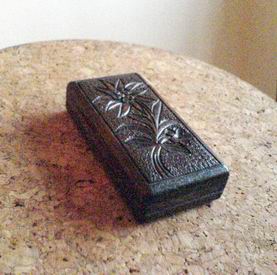
I realized that British people have quite a lot of meals in a day too. Not too long after we had our lunch, Elizabeth was preparing afternoon tea. I was still trying to digest my lunch! haha... While having the tea, Elizabeth showed us her collections of small ornaments, and we were pleasantly surprised to find many Chinese items such as the 文房四宝, some tiny woodern carvings of 18 Lohans (十八罗汉) and 8 Taoism Gods (八仙), and other beautifully carven ornaments. She also inherited a 'trick box' (in picture) from her mum. This trick box cannot be opened unless we trigger some secret latch inside. We spent a fun time trying to figure out the way!

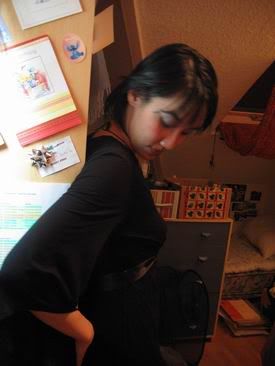
Just when we thought we have had enough food, it was time for a supper! But this time I welcomed the supper, because there's my favourite ribena (only this time it is served hot), and egg on toast! The picture below shows David, Huifang and Elizabeth during the supper. Daivd was in bow and shirt, as he would be singing in a church choir concert which we would go later.


And then we were off for the choir concert! It was held in a local church, and there were 60 people in the choir singing 12 christmas carols, starting with "Once in Royal David's City" and ending with "Ring out wild bells". They sang "Away in the manger" in a different melody, and had a Japanese woman singing "Silent Night"in Japanese, and they certainly entertained the audience with the light-tuned "Past 3 o' clock". We enjoyed the performance, and we enjoyed more the atmosphere of christmas - the love, the friendship, the tradition!


Christmas is in the air, my friends!

Saturday, December 03, 2005

# Video Mania

This news was some time ago, I was so angry when I saw such practice still carried out in Malaysia.

The recent release of the video of the mis-treatment of detainees in lockup by Malaysia police has really been a slap in the face to our country, in terms of human-rights issue, and the system of police force in Malaysia.

The video showed a Chinese woman being forced to perform squats, naked, by a police officer. Another slap was felt when in the middle of video, we heard the distanct background prayers from the mosque.

BBC report & video

What made the public angry was the response by the police side. The deputy police chief stated, as if that is a matter of fact, that the practice is standard procedure, particularly as he suggested the real offender was the person who filmed the incident. The police insistence to find out the 'culprit' who filmed the video, showed the attitude to shift blame rather than to examine the dubious practices in their part, which violates the basic human rights.

I am saddened by the attitude to shift blame and deny responsibilities. Such manouveour has been seen again and again in many fields in Malaysia, be it government sector, organization, companies, etc. Instead of taking the bull by its horn to solve problems, there is a culture of blaming others, or "wait-and-see" to let things 'cool' down. In many cases, an exposure of some scandalous common practice does not lead to further investigation to clean out all the culprits, but is resolved by categorizing them as individual cases. An example is bribery and cronysim, which is an issue that we MUST solve soon, because the longer we wait, the more cumulative the problem builds up, and when it DOES fall apart, everything will fall like dominoes.

More saddening is that it has been commented that such abusive practice has been long existing in our society, and people commonly have the perception that this is actually a NORM or a common practice in the police lockup, and actually treat it as a fact to accept such grey area of the human rights in Malaysia. The "tidak apa" ("couldn't bother") attitude among Malaysians are disasterous. By choosing to shy away from the seemingly sensitive/ complicated social issues, we are shying away from our social responsibilities as citizens. When we escape from the problems that need to be tackled, we cannot escape them forever, for they will always fall back to our own children in next generation, in larger magnitude.

Side note:
Similar news in Marine UK.
BBC

Friday, December 02, 2005

# Rhythm of life

With the prolonged flu that ran in the house (well, everybody got it in turns), and amidst the occasional coughs and nose-blowing, I remembered an interesting hypothesis made by some scientist (I can't recall his name) about living in tune with the rhythm of nature.

His hypothesis stated something like this: The reason that more and more sickness and diseases appear in this world is due to human not living in tune with the rhythm of nature, hence breaking the natural harmonic sequence of life, cycle of survival.

_________________________________________________

Past: We adapt to nature
In the past, life is simple. Seasons come and seasons go. Life is adapted to how season changes. Human work when sun rises, rest when sun sets (well, this is conditioned on we are non-nocturnal animals, hehe). In longer terms, human sow seeds and harvest according to seasons, and rest during winter, where the force of nature is too strong to withstand. In human dietary, people eat the local food, according to what is available during certain seasons and periods. Activities in life are also done according to the suitability of seasons.

Present: We make nature adapt to us
With the advance of technologies, better economic transformation, better transport and communication, more integration of different nations hence better mobility, we expand beyong our small circle of 'local commnunity'. We become global. Human work all day long, all year long, with the comfort of air-conditioned work place, we can afford to work even in the worst condition of weather. Also, all year long, we can eat whatever food from whatever place in the globe, due to efficient transportation and international trade. We travel to many different places, any time, any where.

_________________________________________________

Though his hypothesis sounds very radical, and there is also a tinge of anti-globalisation feel in it, I found that, there is actually some plausible argument in it. True, with the growth of the human race, we are now exposed to a multitude of different cultures, lifestyle, and knowledge. We are becoming global. It is also true that we have, to some extent, neglected the needs to listen to the nature. We now live our life according to how we want it to be, and we don't really have to take too much consideration about following whatever rhythm of nature, because we are somehow "shielded" from it by our own various creations of technologies. We have let nature become irrelevant to us. Nature becomes something that we can set aside as some "issues", not as part of our life. Nature becomes something that we can find "substituttes" for it, should some resources run out, or some livings extinct.

I am not blaming technologies, nor demanding people to revert to totally pre-historic life. I am just wondering, in this fast tempo of life that we are currently leading, do we have time to stop and listen to the rhythm of life? Do we still realize that we are still a part of nature? Are we still be able to survive by means of nature, if someday we have to dispose everything human-made in our 'society'?

Suddenly, I found we are so far from the origin we come from. The same earth that nurtures us from the earlier worlds is still there. But human has changed. I somehow feel a sense of loss, of something within, is it the connection to the rhythm of life? Do you, feel in your heart, the rhythm of the nature?

Saturday, November 05, 2005

# 花と爆弹

I would like to thank pandabonium for his meaningful gift of the book 花と爆弹 (Flowers and Bombs), a book which consists of poems of hopes for a non-violent world. A simple gesture, to change the chain of violence into a chain of hope, to transform bombs into flowers.

The writer, Kaoru Kobashi, request readers to translate poems into the languages that we know, to spread the messages, the love, and the hopes. I tried my hand in one of the poems, to translate into a Chinese version. Hope it sounds coherent. *^_^*

Japanese - Original
青空のあなやるせなきため息か
戰の空の薄い三日月

English Translation - translated by other people
Is it a sigh of
Deep sorrow the blue sky heaved?
Above the battle field
There is a white crescent moon
Blurred in the afternoon sky.

Chinese Translation - YD's translation
听那蓝天的长叹
看那皎洁的月亮
迷蒙在那昏沉的傍晚
伴着尘土飞扬的战场

Let's spread the hope for a better world. For you, for me, for everyone.

# Serenity

What a pleasant surprise when I received two postcards at the same time, both exhibited such tranquility, peace and serenity.

Image hosted by Photobucket.com
I had a virtual tour to Kashima shrine through the postcard from a dear panda in Japan. Kashima Jingu is one of his favourite places, with its magnificent gates, wide paths, sweet cedars smell, lines of cherry trees and chirping birds, etc.. Quote panda: "The shrine is actually the land which has been used as a shrine for 2600 years. But the buildings date back to around 1600. In the Heian era, about 1100 years ago, they used to rebuild the buildings every 20 years." Such was the long history of the shrine, which still stands grandly at present day.

I wonder, what it feels like to walk on the path amidst of blossoms of cherry, listening to the voice of the wind, contemplating on ourselves, our life, in past, current, and future? A walking meditation at such surroundings will be a fruitful one, I think.

Image hosted by Photobucket.com
A second postcard, from Low, conveyed another sense of calmness and quietness. The image struck a familiar note in my heart. This is the kind of environment I used to see in Malaysia when I was growing up. Small villages, peaceful waters, soothing wind, and simple, carefree people. Sea has been an intriguing landscape of nature that shows so much emotions and tells so much feelings. From the gently lapping waters to wild raging strong waves, the sea is speaking to us, telling us stories of the nature, sharing their wealth, their wisdom accumulated from so many years.

One day, when I am gone, I would like my ashes to be scattered in the wide blue sea.

(P/S: Panda, your story of your uncle in California made me decided that my ashes to be scattered from a BOAT, not a PLANE. hehehe...)

Thursday, November 03, 2005

# Selamat Hari Raya Aidilfitri!

Selamat Hari Raya Aidilfitri! Happy Eid!

After a month of Ramadhan (Fasting month), this is the day which mark the culmination of the holy month, the day of the celebration of the Muslim New Year.

During the fasting month, muslims abstain from eating and drinking daily between sunrise and sunset. Smoking and sexual relations are also forbidden during fasting. At the end of the day people break fast with a prayer and a meal called iftar.

Side note: Fasting during Ramadhan is one of the five tenets/ pillars of Islam:
1) Syahada (Belief in one God)
2) Salat (Five times prayer a day)
3) Zakat (Almsgiving)
4) Siyam (Fasting during Ramadhan)
5) Hajj (Pilgrimage to Mecca)

After a month-long fasting, Muslims celebrate Id-al-Fitr (the Feast of Fast Breaking), we called it Aidilfitri in Malaysia, which is the first day of the month of Syawal. Aidilfitri signifies the spirit of forgiving and family reunion. In Malaysia, people from cities 'balik kampung' to reunite with their familities in hometown. During this time, people ask for each other's pardon and forgiveness for whatever past quarrels, by salam (handshake) and kissing the hands of the elders as a sign of respect.

On the first day of Aidilfitri, muslims congregates at mosques for morning prayers. I passed by the East London Mosque which is situated near my house last year, and the voices of prayers from the mosque sounded so homely, I felt I am back to Malaysia.

What I love about Hari Raya Puasa in Malaysia is the culture of Open House, and visits from house to house to wish one another "Selamat Hari Raya". The place I stayed in Malaysia is in a Malay community, hence we enjoyed visiting our neighbours and exchanging gifts and cookies during Raya. I particularly love the ketupat (triangular shaped rice cake) with rendang!

Putting up my baju kurung (Malay Traditional clothes for female), I am ready to pay visits to my Malay friends and wish them

"SELAMAT HARI RAYA AIDILFITRI!"

"MAAF ZAHIR BATIN"

Tuesday, November 01, 2005

# The Story of Light

I miss the murukku! ommapadi! chippi! etc etc... Not being in Malaysia, I have to just settle for a packet of 250g murukku which costed me 2 pounds! :)

An e-card (copyrighted by Compufield) from a friend, K, really warms my heart. A simple wish, a special occassion, just brings everyone regardless of races together. Although I did not manage to go over to my neighbour's house this year to celebrate, nor did I have a chance to watch people make the beautiful patterns of rangoli, I feel the joy of the Festival of the Lights.

The notion of using LIGHTS in the festival gives me a chance to do some reflection, about the significance of light in good over evil, valor, peace, confidence, hope, and enlightenment. Speaking about lights, I recalled a story I read somewhere:

"A girl saw a blind man carrying a lantern in the dark. She felt curious and asked him why he needs a lantern as he was blind. The blind man explained that he wants to lighten up the street so that people can see their way.

The girl was about to praise him for being so selfless to lighten up the street for others, when the man continued, 'I do this for myself. By lightening up the street, people can see their way, and will not bump into me.' "

A simple story, which tells of great teachings on the way we lead our lifes. To light up our world, we must first learn to give lights to others. To shine in our lifes, we must first learn to help others shine. Giving away does not diminish our wealth, or capacity to give even more. We gain more when we give. A simple selfless act which may not see any return, is actually a gread deed which not only cultivates our morality, but also helps us in becoming a better person.

Monday, October 31, 2005

# Halloween --> Hungry Ghost Festival

The Halloween day fell on Monday, but surprisingly I did not manage to find much celebration at school, on street, nor at the place I stayed. This year, I did not find the enthusiasm to celebrate among friends like last year, when we had lots of fun in the parties. Perhaps it's because of the pouring rain and the lousy weather. :-P

We decided to have a walk around our living vicinity to get a feel of the celebration. However, with the population of our area mainly consisting of Turkish and Middle East people, the festive mood is not strong. Instead of getting 'trick or treat', we had nearly been extorted money from some kids, and that's when we decided to head home earlier.

I remembered hearing from a friend that Halloween originated from the Celts' beliefs that every year on the last day of October, the souls of the dead visited the earth. People dress up in costumes and go for trick/treating, costume parades, community parties, etc.

While the celts started the halloween celebration, other countries have different Fall festivals to honour the deceased. We, chinese, besides having the Grave Sweeping Day (Ching Ming) in April, we have the Hungry Ghost Festival (Taoism) / Yu Lan Pen festival (Buddhism) festival in the 7th month of Lunar calendar. This ancestor-honouring festival which continues for the whole month of the seventh month, centered on the 15th of the seventh month. Unlike Ching Ming which is dedicated to one's own family and ancestors, the Hungry Ghost festival is dedicated to the deads who are not one's own ancestors. Being a festival to commemorates the ancestors, this festival's aim is to pacify the uncared-for and abandoned dead. Scary the name might seem, Hungry Ghost Festival is actually a very compasisonate celebration which encourages filial piety.

In the Buddhists' version of Yu Lan Pen festival, there is a legend of the festival which told about a devout Buddhist monk, Mu Lian, whose mother was suffering in hell due to wrong doings. Mu Lian plead to the Buddha for help to save his mother, and he was taught the Yu Lan Pen canon/ sutra and was instructed to offer this prayer and food on the 15th night of the 7th month. As a result of his devotions and filial piety, his mother was then freed from hell. Since then, Buddhist monks and nuns would chant the Yu Lan Pen sutra to rescue others from hell on the 15th night of the 7th month.

In the Taoisms' version of the Ghost Festival, a more elaborated celebration is observed. The celebration includes special sacrificial ceremonies which involves prayers for the dead and offerings of fruits, sacrifices of animals such as pigs, sheep, chicken and geese. A sacrifical altar and a chair is built at street entrances, and in front of the chair sets the statue of the King of Hell Di Zang.

Incense-burning is also another Taoism practise which is seen as a way to transfer 'prosperity' to the dead. In the streets, and altar of incense would be set every 100 paces, with fresh fruits and sacrifices arranged on it.

In places like Hong Kong and Taiwan, people flown water lanterns on lakes/ rivers. Accodring to the Chinese tradition, the lanterns are used to guide the ghost in the dark. The priests will then invite them to attend the next days' feast. In many other places, stages are set up and there are performances of songs and dances, called 'shi ge er', which mean singing ghost songs, to entertain the dead.

I remembered when I was small, I used to feel scared when the Ghost Festival draws near, afraid of being disturbed by wandering spirits. But after growing up and understanding the significance of the festival, I feel so touched that we have this meaningful celebration to show our compassion not only to our ancestors, but to all other deads. Suddenly, the ghostly statues and the weird-tuned songs don't scare me anymore.

Saturday, October 29, 2005

# Art of Procrastination

Just trying out a few more patterns... Still too lazy to start the piling homework.
Low, Pandabonium n Moody, I will just take you guys as guinea pigs then... *^_^*

Image hosted by Photobucket.com Image hosted by Photobucket.com Image hosted by Photobucket.com

(P/S: Low, your second character looks uncannily like the 'shan' 善 in Chinese words.)

Friday, October 28, 2005

# Seven

Got tagged by Low to this 7-chain. (hehe you owe me one meal!) As I went on to fill in the blanks, I realized I was more mindful and aware of myself...

7 things I plan to do before I die
1. Travel across the globe (condition: get some money first)
2. Go to Tibet
3. Short term nun (短期出家)
4. Be a mother
5. Make a useful contribution to Malaysia
6. Write a book. (childhood dreams!)
7. Buy my parents a beautiful house at a serene place.

7 things I can do
1. play piano
2. talk incessantly
3. fall asleep in 1 minute (my friend actually counted! geesh..)
4. laugh easily
5. recite ABC alphabets in inverse order, and other kinds of silly games
6. do mathematical proofs, such as Image hosted by Photobucket.com
7. spend long hours just walking and thinking

7 things I cannot do
1. dance :-(
2. ride motorcycle (my dad wouldn’t let me)
3. skate (centre of gravity too high, :-P)
4. normal-girl-shopping (I think I m from Mars)
5. drink coffee (I mean, I can drink, but I will end up staying awake for whole night!)
6. sit still for too long (roommate’s comment)
7. body mechanics – cartwheel/ dive/ climb monkey bars

7 things that attract me to another person
1. Sincerity
2. Simplicity
3. Integrity
4. Compassion
5. Open-mindness
6. Considerate
7. Fun & entertaining

7 things that I say the most
1. huh?
2. haha…
3. omigosh
4. thanks
5. Yes-su (Saying ‘yes’ in a Japanese way)
6. …it’s like…
7. okay

7 people I want to do this
1. HF from Taiwan
2. KB from Japan
3. SS from Malaysia
4. EH from UK
5. Lisa from UK
6. NBSM from Malaysia
7. Anyone who feels bored, hehe

Thursday, October 20, 2005

# A Melting Pot of cultures

A familiar picture among stacks of envelopes caught my eyes when I was rummaging through the mountain of mails. (There are 4 flats sharing the same mail box, at the place I stay now...)

A postcard from Malaysia! What a delight! It's from my dear friend, Low, who himself loves collecting postcards. Somehow, we have started to exchange postcards, hence started this series of postcard stories. Just two days ago, I was surprised by the appearance of my Big Ben on his blog, 1979.

Anyway, here is the wonderful postcard that tells the story of Malaysia.
Image hosted by Photobucket.com
Batu Caves (Left), Thean Hou Temple (Top Right), Masjid Jamek (Bottom Right).

Such was the variety of races, cultures, and religions in Malaysia. While Batu Caves has always been a site for Thaipusam celebration by Indians, Thean Hou Temple is one of the grandest chinese temple not only in Malaysia, but in Southeast Asia. Also, Masjid Jamek is a significant starting point of the history of KL.

Besides the historical values exhibited by the places, I am impressed by the implicit meaning conveyed through these snapshots. With the three religious sites of three races, the pictures potray the multi-racial and multi-cultural society of Malaysia. Malaysians have always been proud of the rich culture and strong unity in our country. And the tolerance and freedom of religions have enabled places as such to be built, and cultures to grow and integrate with one another. The wonderful thing is, despite the differences in backgrounds, Malaysians easily mix among races and celebrate various festivals together, no matter what race you are or what religions you have. There is an evolution of Malaysian culture, rather than the distinctive cultures of different races, that makes us feel at home, and feel together.

One special Malaysian culture is the "Open House" culture. During festivals and celebrations, Malaysian fellows love to throw an Open House party, which invites anyone around the neighbourhood to come and celebrate together. With such 'policy', no specific invitation is needed at all, everyone comes and gives good wishes to the host, who happily welcome anybody. With such concept, people are friendly to any visitors, and the atmosphere is filled with trust and friendship.

Another strictly Malaysian culture - Mamak Stalls - the best hang-out place for youths at night. Sometimes people see this as a unique version of pubs for Malaysian, but of course, no alchohol is served. :-) We prefer Teh Tarikkkkk...

Well, I should stop going on and on.. Once I have started, I always get excited and would get deeper and deeper into discussion. hehe...

Image hosted by Photobucket.com
One last thing I gladly noticed on Low's postcard, the Stamp which depicted the 600th anniversary of Malaysia-China diplomatic relation, and showed a picture of the Chinese Junk sailing. I love this stamp! Maybe it's because of my interest in reading Cheng Ho's (or Zheng He) exploration, especially in the recent debate about the extent of his ships' travel around the world, after the "1421" came out. Cheng Ho has left quite a legacy in Malaysia, with some of the chineses today still visit the Sam Po Temple erected to venerate him.

Thanks so much Low, for the lovely postcard, and for the chance for me to launch into another ramble. hehe...

P/S: Thean Hou Temple is a very significant temple for Hainan people in Malaysia, and I am a Hainanese. This means a lot to me, thanks so much.

# Deepest Condelence

This morning I was browsing the news quickly before I left home for school, and the headline that caught my eye was shocking. I was left speechless and a sudden grief overwhelmed me.

"P.M. wife dies after bout with breast cancer"
The line reads at the Star Online.

Such strong character, such gentle heart, Datin Seri Endon Mahmood has passed away.

I could not understand why my heart felt so painful, although I have not known her personally. I think, this is the kind of feeling that grows within us as being part of the nation which we are so proud of. She has been a woman who has shown much personality, character, principle and values. Malaysians have been proud of her, just as Malaysians have been proud of our P.M.

With 5 minutes to class, I would have to stop here. My deepest condolence to her, her family, and to Malaysia. We will remember her.

THE STAR ONLINE

Tuesday, October 18, 2005

# Rajmohan Gandhi Talk

Today I followed Huifang to the MRA Office in London. They are having a meeting for the preparation of the talk of Rajmohan Gandhi in November, and I tagged along with Huifang to see where I can help out.

Yes, you heard it right. Rajmohan Gandhi, the grandson of Mahatma Gandhi, is coming to Britain in November for a series of activities. Further information please press HERE.

From the discussions, I jotted down some points to follow up, as I have thought of a few actions we, the youths, can help out as volunteers.

1) Promotion/ Advertising
Was told that the target audience consist of students in social sciences, political and international relations, and the topic would mainly deal with the various issues in today's world - terrorism, peace talks and reconsilliation, relations of Hinduism and Islam as well as between West and Islam, etc etc...

Judging from the target audience and the theme, I found there is some things I can do within my limit.
- contact LSE SU for bulletins in the Beaver, LSESU weekly emailing list and permissions to put up posters on event board.
- contact friends in Islamic society, Malaysian society, BLIA, International Relation repadtment and other societies to help promote the event.
- Discuss with the Communication Officer in LSE for promotion of this event in the community of academic staffs too.

2) Volunteers
As they need volunteers in organizing the events, I am thinking of getting manpower from the students community.
- contact ULUBUDA for prospective volunteers to help out in the event.
- contact LSE Volunteer Centre to register this as a one-off event/project to recruit volunteers.
- Food catering costs seems high to me. hope to ask some catering friends to find some cheaper prices.

Well... i better stop here. Seems I am making this into a notebook to myself of lists of Things-to-do. haha...

Anyway, the full information about this upcoming event is HERE.
The PDF format of the information is HERE.
The summary of the event is

PUBLIC LECTURE
Title: Responding to Today's World - The Relevance of the Gandhian Ethic
Speaker: By Rajmohan Gandhi
Date: Wednesday 23rd November 2005
Time: 7.00pm (doors open 6.30)
Venue: Friends House, 173 Euston Road, London NW1. (facing Euston Station)

Enquiries: 020 7798 6000
Website: www.uk.iofc.org
Email: info@uk.iofc.org

# "Mao: The Unknown Story"

Jung Chang and John Halliday, co-authors of "Mao: The Unknown Story", came to LSE for a public debate organized by the Cold War Studies Centre of LSE. They were joined by Professor Michael Cox,Professor Arne Westad and Dr Athoo Hussain. The interesting feature of this event is such that it took the form of a Q&A session rather than debate among panelists.

From the talks and debates, it can be noticed that the main issues lie in the perspective to see Mao. While Jung Chang sees Mao from a more human side, by exploring his character, behaviour and doings through writing the biography, other academics are looking more towards his ideology, his campaigns, regimes, and the way he made an impact in the landscape of the global politcal map. Due to the difference of perspective and focus, the panelists disagree with one another and argue for own cases. With Jung Chang and Halliday pressing on various cases of Mao's cruelty, and Dr Athoo arguing on the lack of focus on the ideology maoism and the intrinsic value of academic research, political shaping and social impact of the teachings, the event turned into a lively debate with a lot of new fresh ways to see the issue. And as the audience came in with questions and views, I found this session enjoyable, being able to see people making their stand, presenting facts and figures, stating their opinions and arguing different aspects of Mao.

Although this book revealed many new ways to look at Mao, and offered lots of new 'evidence' that has never been made public before, I found there are some limiting factors that open the room for criticism too. From the way the authors described the contents of the book, the way they shape their argument and their emphasis on the issues, I noticed that there seems to be a factor of personal stand towards evaluating Mao as a person. Jung Chang family suffered a lot under Mao's regime (many other Chineses have too), and I suspected this factor weighed quite a lot in the motivation to write the book and shape the character of Mao in this book.

I feel, one issue which needs to be addressed by this book, is that despite Mao's well-known cruelty and sinister policies, how can he manage to attract such huge number of followers? What is his appealing factor that made the Chineses venerated him so much? With his complex character, how can he manage to leave such huge legacy to the current China, with his portrait still looking over Tiananmen? Considering these factors, we note that Mao does have great qualities as a campaigner, a politician and a revolutionist. It would be interesting to look into these aspects of how one leader can influence a population of followers so much, how an ideology can expand with campaigns and policies. Well, such issues will lead to social and political studies then, which I should make way for the specialists. :-)

Another question in my head is the source of information that the authors used for obtaining all the information which have been unobtainable all these years - the speeches, the reports details, the facts, figures, the quotes of words, etc... A Chinese girl in the audience challenged her about the source of information, but the only answer give is 'classified'. I feel there needs to be more clear explanation for all the new evidence put forward about Mao, because every piece of new information matters a lot - in changing the political and historical records in this area, as well as in changing society's views and understanding about China.

The debate ended later than previously arranged in the timetable, but audience found it interesting and informative, and solicited great interest from the LSE community. I myself enjoyed the event, and although I have not read the book, I think it is a good book for sociology/ policical studies material. Despite its controversial and daring views, it presents some new ways to look at the issues, and give rooms for debates and more research studies.

Saturday, October 15, 2005

# On My Own

ON MY OWN (from LES MISERABLES)

And now I'm all alone again
Nowhere to turn, no one to go to
Without a home without a friend
Without a face to say hello to

And now the night is near
I can make believe he's here
Sometimes I walk alone at night
When everybody else is sleeping

I think of him and I'm happy
With the company I'm keeping
The city goes to bed
And I can live inside my head

On my own
Pretending he's beside me
All alone
I walk with him till morning
Without him
I feel his arms around me
And when I lose my way I close my eyes
And he has found me

In the rain the pavement shines like silver
All the lights are misty in the river
In the darkness, the trees are full of starlight
And all I see is him and me forever and forever

And I know it's only in my mind
That I'm talking to myself and not to him
And although I know that he is blind
Still I say, there's a way for us

I love him
But when the night is over
He is gone
The river's just a river
Without him
The world around me changes
The trees are bare and everywhere
The streets are full of strangers

I love him
But every day I'm learning
All my life
I've only been pretending
Without me
His world would go on turning
A world that's full of happiness
That I have never known

I love him
I love him
I love him
But only on my own.

# Karma Talk

Quoted from Samyutta Nikaya I (227):

"According to the seed that's sown,
so is the fruit ye reap therefrom.
Doer of good will gather good.
Doer of evil, evil reaps.
Sown is the seed, and
thou shalt taste the fruit thereof."


From a wise friend's blog, Pacific Islander, we got into the discussion of karma. Simple it may seem, but the intricate layers of meaning, and complex field of karmic force, are yet to be understood, and explained by human.

Many of us see karma as 'reaction' upon one's 'action', harvest of our good deeds, comeuppance upon our bad deeds... This is a very common misconception, if not, violation of meanings of karma. We treat the subject too lightly and we simplify it to just like any other physic laws. Although there are some people's effort to categorize the karma into various types, like supportive karma, obstructive karma, destructive karma, etc, the truth is, we still have not completely fathom the idea of karmic interaction, and cannot explain it just like a subject in school.

Definition ot Karma includes "action, doing, word, deed, thoughts, etc". According to Buddhism, there are two types of existence - current existence and transient existence. The first one refers to the form of being currently, although not permanently, existing, such as human, animal, self. The second one constitutes of the fleeting form of mental and spiritual processes which are forever changing, being transient and impermanent. This leades to the five Aggregates in Buddhist teaching - Matter, Feeling, Perception, Mental Formation, and Consciousness. Karma is a process that happens in these entities. Some see it as the result of actions for past life, some treat it as the reaction of our actions, some say it is just a fleeting moment of process, the moments we think, we act, and react.

Classification of karma is hard. Not only we need to take into account of the various types of good/bad karma, we need to realize that there are far more complex interaction among the karma, the cumulative effect, supportive effect, or sometimes, annulling effect. We have to take into account the factor of time of the effect to take place, be it immediate, subsequent or even indefinite. And from some books, karma study even involves the many planes and dimensions of the karmic consequences, the forms and fields the karmic processes take place. Sometimes, karma is treated as some kind of reserve, where good and bad karma decide the content of the reserve as a whole in a cumulative way; but sometimes, an action is independent of the others.

With such intricate net of Karmic conditioning, there might be questions whether it is worth studying, or even worth believing. It is, and it should be. Though the workings of Kamma surpasses our understanding, it provides a teaching of moral and spiritual responsibility for us. The fact that the Law of Kamma does not operate with mechanical rigidity allows us to have a moment of choice to rise above our bad karmic past, instead of being doomed to predestination and definite fatalism. Also, even for good people, there might be a bad karmic past which has not reaped yet, somewhere from past moments/times/lifes. It is with wisdom, and mindfulness, that we can understand the very transient moment, and make our choice.

I still don't know how to explain karma, and I admit I still do not understand karma; but by writing these down, I hope I can arrange my thoughts and have a better understanding about it. Karma, is not just a religious or philosophical topic, it is in the many moments in our life, it is the unseen force that revolves around us, senseless, tasteless, colourless, formless, yet, it is there.

Monday, October 10, 2005

# Climate change - a warning?

Debates have risen after the attack of Hurricane Katrina and Rita, as well as many other typhoons in Asian region, over whether climate change was a direct factor in contributing to rise in hurricane activities.

There were claims that global waming was causing an increase in sea surface temperature, hence resulted in more severe hurricanes and storms. There were also suggestions that greenhouse gases is linked to the increasingly horrific weather. In fact, two prominent studies, as reported by FT, seemed to confirm the theories.

Are the recent disasters a kind of signal? A signal that gives us a warning that climate change is a serious issue to be tackled with high importance? If they are, are human looking at the problem seriously? Or are we just brushing it aside, again and again, as long as we are not too much 'affected' by the rage of the nature?

We must act. Among the key issues relevant to climate change and global warming include the effects on food industry, travel and tourism sector, control of emissions in developing countries, and design of technologies that is 'greener'. However, all talks and no action would not solve the problem of hazardous gases emission, greenhouse effects, global warming, etc... We need ACTIONS, instead of just rounds of talks and debates, with no immediate fruits of actions. Do we remember the Earth Summit in Rio, 1992, or the negotiations for Kyoto Protocol in 1997? But do we remember how long does it take for them to bear results? Do we remember doing what we have been saying?

Climate change is not just a so-called 'environmental' issue that many people tends to ignore, thinking that it is irrelevant to their lifes which have more 'important' things to tend to. Climate change is a global issue, which affects everyone of us, as long as we live on this earth. We cannot stand aside and watch the worsening of our environmental state, we have our responsibility. Earth belongs to everyone; however, sometimes it is ironic to see people claiming the wealth of minerals and resources produced by earth as their 'rights and properties', while shying away when it comes to the issue of tackling environmental issue. As we gain economically from nature, let's not forget that we still have our responsibility to take care of it.

A simple habit is 'Give and take'. Sadly though, we seem to have been taking too much and forgetting to give in return. And most importantly, to give in return means by practical, realistic actions, not just by beautiful words, discussion or promises.

Friday, October 07, 2005

# Where have our ethics gone?

I was shocked to discover that the main tactics used by friends in interview to apply for job/internship is by BLUFFING/LYING. Rather than using concrete examples which show qualitites needed for the job, people make up stories and 'invented' work experiences that make them look good. And most surprisingly, many are actually proud of themselves for being able to bluff through the interviews and get the jobs.

Suddenly I felt so ashamed for our fellow students. I just could not believe that the eagerness to get into a good company can encourage students to start making stories just to meet the requirements. I feel sad for the recent development of 'skills-targeted' employment procedures. As the companies state the 'perfect' qualities of prospective employees, suddenly everyone 'transforms' into perfect humans with lots and lots of wonderful experiences, or should I say, imaginative experiences.

Application forms are filled with bullshit and non-existence flamboyant words and accounts. Interview process, originallly aimed to get to know applicants better to assess their personality and skills, has transformed into a story-telling session. I am 'impressed' by such development in the career pursuing ratrace. Interestingly, with the increasing demands on human resource skills, the quality of worker does not exactly rise, but rather the skills of bluffing enhance.

How low can we get? How far can we compromise our ethics for material gains? How profit-minded can we be? How individualistic and materialistic can we be??

Today I felt disappointed with my own friends, and I felt sad for the society. I hope for a change, a change in culture, a change in mindset, a change in human nature.

Thursday, October 06, 2005

# Global Risk: How Civil Society Responds

Just went to a public lecture in LSE Old Theatre, titled "Global Risk: How Civil Society Responds". Speakers include Professor Lord Giddens (former LSE director), Professor George Gaskell, and Professor Mary Kaldor.

The lecture focused on the increasingly important role of risk in the global society, and with the advancing application of risk in everywhere, it is vital to answer a few main questions:

- What is risk?
- Why is risk important?
- How is risk relevant to us?
- Who define risk and its benefits?
- Who does risk management benefit?
- How much of risk is tolerable?
- etc etc etc...

From the lecture, here is what I understand about risk and its implication onto the global society, a.k.a nations across the world.

Formal definition of risk (from ST330 module: Stochastic and actuarial methods in finance) is potential for unexpected events to occur or for expected events not to occur.

More intuitive approach: Risk refers to future, uncertainty and involves calculation and measurement. There is a difference between risk and uncertainty, in a sense that risk is measurable, while uncertainty is immeasurable.

Well, it is getting a bit boring with all the definitions so I should get into the points.

History/Background
In the past accidents are characterized as acts of God, nature or just by luck. There is no sense of insurance and predictive measures to account for risk. Peter Bernstein's book "Against the Gods" mentioned the starting of the notion of risk in the voyagers' exploration records. In 1970's, the notion of risk became exponentially important and suddenly we see risks everywhere, and we find applications of the knowledge of risk everywhere.

Current Situation
Risk is deeply ingrained in our life, as our society is future-oriented and globally integrated, and there is a rise in the incidents of man-made risks. Professor George Gaskell described the phenomenom of a "Risk Colonization", where we see risk measurement, management and control in every sector, from health to law to finance. By employing the notion of risk, we aim to increase efficiency and assist in our decision-making process in uncertainties.

Risk management is observed in various social issues - tsunami preventive measures, terrorism control, climate change management, gender difference, migration problem solving, etc etc. With the widening application of risk management in everyday's life, there is, however, a potential threat of "Risk of risk", in which the process of managing society risk leads to institutional risk, which causes a spiral effect of risk creation. With so much of the 'known' unknowns and 'unknown' unknows, the global society needs to decide which risk is tolerable, and which is relevant?

Besides the spiralling effect of risk that Professor George Gaskell mentioned, Professor Lord Giddens explained about the issue of informing the public about the risks they are facing. There is a fine line between scaremongering and coverup in risk control in public. How much do we want to expose to the public? and how much risk we can take?

With globalization, the notion of risk developed from social contracts, to national policies, and to global convenance. As the knowledge grew, we noticed the gap between political party and the society, and we saw the different weights carried by the rich countries and the poor ones in deciding the risks and methods to counter them. Professor Gaskell raised one crucial point, "Who defines risk and the control methods? Who does it (risk management) benefit? What level of risk is reasonable?"

There is also another issue of the increases in the 'blame culture', reported by the New Scientist. Human have collectively become more inclined to blame than we used to be. The increased frequency and size of litigation and compensation amplified the society's tendency to start blaming one another for any risk and any accidents. Where do we stop, and how far we want to assess the risk in everything?

There is still much room for debate in the application of risk in our society. I do not deny that risk is an important element in our life, in fact, I myself study the subject that deals mainly with risk assessment, management and control. Risk gives security and stability, but the global society needs to have intensive public debates, proper analysis and deep research on risk to manage risk properly, and prevent exploitation of this wonderful idea by certain irresponsible groups. With the notion of risk spreading from finance to larger perspective of global/ social issues, there needs to be a careful examination on the control measures and application.

One last thing I am still waiting for a reasonable explanation: Certain people use the name of risk to carry out pre-emptive actions, supposedly as 'preventive' measures to protect the world. Yet, have we properly assesed the risks, our tolerance for the relevant risks, and the realistic probability, if not, the proofs of the risks? We need to think more, and we need more global participation in decision making rather than power concentration in a few big powers.

Tuesday, October 04, 2005

# Great Ideas that Shaped our World

The recent cover story of New Scientist really attracted my interest - "The World's Biggest Ideas".

Top Ten Scientific Ideas

1) The Big Bang - the concepts that describes the origin of universe. It was proposed that after a few seconds of the beginning of the universe, the temperature was 10 billion degrees high; radiation, protons, neutrons and "dark matter" were present in known proportions. Then everything cools down, and with action of gravity, density contrasts grow and gradually form our universe.

2) Evolution - Darwinian Theory. Cumulative evolution is guided by the force of natural selection. Life starts with a single bacterium, and diversity stems from successive branchings (Speciation), and evolves into different species. Survival of the fittest.

3) Quantum Mechanics - study of how subatomic particles behave and provide a framework for physical theories. The article linked quantum mechanics to abortion, free will and human identity. Interesting subtle links.

4) Theory of Everything - theory of general relativity, gravity, string theory. Dimensions, forces and particles. We have yet to find such a kind of Theory which encompasses Everything. But we will try.

5) Risk - Quantifying risk and differentiating between risk and uncertainty, measurable randomness or uncontrollable acts of God. Growth of the blaming games, litigation and compensation culture. Risk assesment, management and control. In fact, the fundamental notion of my current study.

6) Chaos - Unpredictable, the world is packed with possibilities.

7) Relativity - Einstein! Mass can be converted into energy, speed of electromagnetic radiation is a special scale of nature. Einstein's relativistic theories also redefines the way we think on intuition, and change the absolute concepts which were once so deeply ingrained in our views.

8) Climate Change - global warming, iceberg melting, fllods, draughts, causes of recent Katrina, etc etc...

9) Tectonics - Study of Earth Sciences, geology, plates movements, plate tectonics.

10) Science - pursuit of truth, to answer everything in the universe. Combination of theories and experiments. Suddenly reminds me of the X-file "The truth is out there". hehe.

Enough blabbering. Back to work now.

# Part-time Catering Assistant

I started work today as a part-time catering assistant in the school cafe. I was quite lucky to get this job because it has been said that students applying to school jobs normally have to queue in the waiting list for quite a long time.

I was stationed at the Plaza Cafe next to the library, although we are told that we might be stationed in any other cafes if needs arise. The cafe is a small one, but a busy one too. My shift is during lunch time, the peak hours of students getting off classes and coming for food. It was hectic to keep everything in order, from maintaining the coffee machines, to refilling food stocks and cleaning up tables and emptying rubbish... etc etc.

Made a few blunders during first time trying. But happy that things are getting into place. It feels nice to be busy actually. Guessed I am not a person who can sit quietly long enough, hehe...

After starting the job, I was quite surprised to find out that some people actually think waitressing is a low-class work. Perhaps these people have always been used to being served upon and being rich. They really needs to learn to respect everyone's job, from the supposedly high status office work/ CEO/ advisors/ etc to lower income workers. There is a need for these people to climb out from their own cocoon to the real world. The world does not revolves around themselves, hehe.

At workplace, got to know a few nice colleagues. Gosha is a friendly girl from Poland, currently finding postgrad courses to study, planning to do IELTS and also finding accommodation. Katy, another Polish girl, is working long hours at cafes and bars to earn a living. Annie, from Malaysia, is the supervisor, and she's on working holiday visa. Leila, Philipine based in Madrid, was travelling from places to places to work. Each person has different stories and background, yet they are a family in this small cafe. I like the friendly atmosphere in here.

Tomorrow I am having another shift. Looking forward to the new day!

# Islamophobia

600% increase in religious hate crimes in UK after 7/7.
Attacks on mosques, arsons and mearing of bacon acros the doors.
Verbal abuse and physical attack of Muslims.

Such was the backlash against innocent Muslims after incidents of terrorism. I was surprised at public's immature thoughts and actions. For terrorism acts by some individuals, the whole community took the blame. Medias have been resposible for shaping the themes which seem to demonize the Muslim community and link Islamic religion with terrorism.

It was unsettling to realize that xenophbia is still wide-spread among the society here. With such developed society and advanced nations, why can't we embrace the simple values of tolerance of each other and acceptance of people different from us? I cannot understand what is the point of racism at all. Why can certain people denounce anything different from their tradition/race/values? It is not like their own values are superior to any other's.

Growing up in Malaysia, I am grateful that I learned tolerance among races since small. It is easy for us to mingle together without being very aware that we are different from one another. Multicultural society in our country seems to have form a strong foundation for our national peace. At least, we are not that sensitive that people are different from us. At least, we do not fear other people because we are not familiar with their culture. At least, we are not too proud of our own values and despise any other different cultures.

Tolerance among races and religions. So fundamental, yet so hard to achieve.

# Incitement Hate Laws In UK

Post London 7/7, the government unveiled plans to ban incitement to racial hatred, to protect people from being abused because of religious faith. It would become illegal to knowingly use words/ behaviour which are threatening and abusive against individual because of their beliefs. When asked to explain the new laws, Lord Chancellor Lord Falconer told BBC that people "attacjlomg the values of West" or "glorifying the acts of suicide bombers" would face actions of laws and "deported wherever possible".

Interestingly, these laws seem to have unclear distinction between criminalising words and deeds. With the principal of justice in which prople are held accountable in law for actions rather than opinions, the new thought-crimes-laws seem to hit the freedom of speech right in the face. It is a scary thought to know that now, we can be imprisoned for expressing our though and opinions.

Suddenly we found ourselves attacking at our own democratic principle of freedom of speech. The society today seems to have become so frail to withstand speeches/ opinions and thoughts. Fighting terrorism needs problem-tackling at early stages, but ruling out people' voice does not directly solve the problem. Tackling problems at the root level does not mean censoring speeches or covering up the ears of public. Banning people's voices only gives the impression that their opinions are something worth listening to.

With such increase in pre-emptive action, the world has suddenly become so full of distrust and suspicion. We penalize people for their thoughts, we attack people because we fear to be attacked. Such actions shows our own insecurity and lack of confidence for our own regimes, principles and social structures.

What we need i a more comprehensive plans and actions to counter terrorism and reduce inter-racial hatred. Banning speeches and deporting clerics do not guarantee that the problem will be 'shooed' away. We need open debate, we need understanding among races and religions. In fact, everything boils down to the most fundamental values in society - to respect one another, to tolerate and to understand one another. It is surprising that many of us today cannot even perform such simple task and follow such basic moral values.

Monday, October 03, 2005

# Sick of advertisements

I have to say I am sick of the surging advertisement appearing in my "Comments" Box. They always start like this,

"Hey you have got a great blog. Good work! I have a blog about blah blah blah, welcome to visit my blog to have a look! would be grateful if you drop me some comments... blah blah blah..."

Gosh! it seems that people take every single opportunity to advertise their merchandise. Even the little comment boxes, which are meant to let friends leave messages, are not spared.

Perhaps I shall just set the setting of this blog to be "Private". geeshh...

# Oxford Circus vs Cambridge Circus

A question suddenly popped up in my mind, why is that Oxford Circus is so famous, but not Cambridge Circus?

# Oxford Circus, the intersection of Regent Street and Oxford Street.

# Cambridge Circus, the junction of Shaftesbury Avenue and Charing Cross Road.

Both have busy streets, both have a variety of stores. Perhaps the difference is that Oxford Street has more 'shopping'-type stores... I do not know.

Almost all people know the location of Oxford street, but not too many would know exactly where Cambridge Circus is, or even whether it exists.

Snapped some shots at the Street name plates, here's the Cambridge Circus sign:
Image hosted by Photobucket.com

Here's the more famous one:
Image hosted by Photobucket.com

Sunday, October 02, 2005

# Egg Growing

My Birthday Egg has mutated!

With an unknown reason, my Eggy has grown a patch of black spot on his head. looks as if he has suffered a bruise. Surprisingly he still has the happy toothy grin as ever.

Poor thing... I can't wait for his growth. It is like a mother watching her child grow. hahaha...

Here's his pictures

Image hosted by Photobucket.com
Day 1 and Day 2

# Waltzing Matilda

Waltzing Matilda
'Banjo' (A.B.) Patterson, c. 1890


Once a jolly swagman camped by a billabong
Under the shade of a coolibah tree
And he sang as he watched and waited 'til his billy boiled
You'll come a-waltzing matilda with me
Waltzing matilda, waltzing matilda
You'll come a waltzing matilda with me
And he sang as he watched and waited 'til his billy boiled
You'll come a-waltzing matilda with me
Down came a jumbuck to dri-ink at that billabong
Up jumped the swagman and grabbed him with glee
And he sang as he stuffed that jumbuck in his tucker-bag
You'll come a-waltzing matilda with me
Up rode the squatter, mounted on his thoroughbred
Up rode the troopers, one, two, three
"Where's that jolly jumbuck you've got in your tucker-bag?"
You'll come a-waltzing matilda with me
Up jumped the swagman and sprang into that billabong
"You'll never take me alive!", said he
And his ghost may be heard as you pa-ass by that billabong
You'll come a-waltzing matilda with me


A friend suddenly asked this question about what's with the Waltzing Matilda in Australia... Dumbstruck. Another friend answered it effortlessly.

It seems that there are some arguments that the song is a political statement to attack political figures in earlier centuries on the squatters’ refusal to pay shearers higher wages. However, it has been argued that the plot of ‘Waltzing Matilda’ is based on the conflict that raged between these two groups in the 1890s before the song was composed.

More information on the National Library of Australia
Waltzing Matilda

Saturday, October 01, 2005

# Buckingham Palace Summer Opening

Buckingham Palace, the official London residence of the Royal family since 1837, home and office of Her Majesty The Queen, is opened to visitors on regular basis. The Summer opening ends on 30 September, and unfortunately I missed the chance to go in and have a look as all the tickets are sold out like hot cakes.

Quotes from the Official website of the British Monarchy (www.royal.gov.uk):

"The State Rooms of the Palace are lavishly furnished with some of the greatest treasures from the Royal Collection - paintings by Rembrandt, Rubens, Vermeer, Poussin, Canaletto and Claude; sculpture by Canova and Chantrey; exquisite examples of Sèvres porcelain; and some of the finest English and French furniture in the world."

I missed the chance to stroll in the garden where which potrays the Garden Front of the Palace and the 19th lake.

I missed the chance to see the "White Wardrobe" desinged for Queen Elizabeth the Queen Mother by Norman Hartnell. I also missed the spectacular diamond jewellery in Hartnell's creations.

I missed the chance to see Cecil Beaton's famous series of photographs showing the State Visit to France by King George VI and Queen Elizabeth in July 1938.

I missed the chance to see all other extraordinary gifts...

All the treasures, awaits in the Buckingham Palace. And yet I missed this chance to visit. I can only wait until next Summer. :-(

# Happy Birthday to me!

Felt quite surprised and touched today to receive many unexpected calls and wishes from friends... Phone calls, sms, email, friendster... A short message means a thousand words... Also felt touched when some went all the way to buy gifts...

I guessed I have been quite cheeky today, forcing everyone that wishes me to sing a Full Happy Birthday Song to me! It was quite fun pestering people to sing, especially to those who had never really sing out loud in public before. But it's great to see that everyone is very sporting! Thanks loads buddies! Will sing to you at your birthday too! hehe...

Thanks so much friends! So many people to thank, I can only express my gratitude and happiness to all of you. thanks especially to YY, sinsin, anthony, Joey, ah phang, tzuenkiat, yuhjiun, voonsan, chunhong, liciang, daryl, phannee, liangqin, chialin, chinloon, johwee.... etc etc etc... pardon me cuz i cannot manage to write down everyone's name... but you know what my heart wanna say, ya!

Special message for YY... Really thanks so much for everything. you've really made me feel 'special' today. and thanks so much for all the help you have given me last time. very very thankful to you. you r a true friend whom i appreciate very much! muaks! lots of love, hugs and kisses...

Some pics...

Image hosted by Photobucket.com
With the little gifts...

Image hosted by Photobucket.com
At Wetherspoon with ray n phang, 'wuliao' so take pics while waiting for food.

Image hosted by Photobucket.com
At Paul Teahouse, Rasberry tartlet, strawberry tartlet, peppermint tea and earl grey. thanks YY for the cute Stitch! Love it! but still i wanna smack you for not listening to me... grwww...
YY insisted that her photo not to be taken. you wish... kekeke..

Image hosted by Photobucket.com
Yuhjiun's egg gift... will update more about its daily progress. supposedly to grow into a tree that says "Happy Birthday". Let's keep our fingers crossed.

and thanks yiing, I forgot to take pics during our warm and nice lunch at CNR, and a nice little reunion and chats... suddenly realized we have grown much five years after Form 5, Sin Min. Things change, people change, but our friendship stays. Ganbate!

Well, tired after all the meals and walk and talk and shop.... I shall have a good night sleep tonight. Thanks again for all the wishes...

# Our room!

Decided to have some photos of our little room, which manages to fit in two people...

Image hosted by Photobucket.com
My Study Table

Image hosted by Photobucket.com
My Decor Corner

Image hosted by Photobucket.com
My 'bookshelves' made from recycled boxes

Image hosted by Photobucket.com
My bed secluded in a corner

Friday, September 30, 2005

# SARS News

** Bats a 'likely source' of Sars **

A new study finds a virus very like Sars in Chinese bats, indicating they were the likely source of the 2002 outbreak.

BBC

Comment from a friend: "notice that Xinhua, pretty much the unofficial "official" mouthpiece of the Chinese government, hasn't "picked up" the story on SARS...or at least I couldn't find it on the main page, the Health page, or SciTech page. Interesting...since they usually pick up on other stories pretty fast...perhaps we'll have to wait for an official Chinese response...or we may never see it appear on the page."

Let us wait...

Xin Hua

# City of London

Image hosted by Photobucket.com
Dragon statue at Temple Bar Monument, source (Wikipedia)

Was told by Ray that at the boundaries of the City of London, these dragon statues guard the City. In each road leading towards the City of London, there will be these dragons, commonly believed to be griffins, guarding the entrance, protecting the City in a mystical way.

Only after being informed by him, I started noticing the little dragons standing by the street. All the while I have not be mindful enough to notice the significance of these statues; there have been so many statues and monuments scattered near the streets that people sometimes took for granted. Near LSE, by the Thames River, there were so many monuments, including the obelisks from Egypt, standing quietly without too many people noticing their stories. I felt embarassed by myself, for not taking just a little bit more time to read the carvings on the monuments, just to understand more about the history.

With such remorse, I decided to look into the City of London in more detail by finding information from the web.

Information from Wikipedia: The boundaries of City of London (such a long one!!!)

"The City of London borders the City of Westminster to the west - the border cutting through Victoria Embankment, passing to the west of Middle Temple, going east along Strand and Fleet Street, north up Chancery Lane, where it becomes instead the border with the London Borough of Camden. It continues north to Holborn, turns east, continues, then goes northeast to Charterhouse Lane. As it crosses Farringdon Road it becomes the border with the London Borough of Islington. It continues to Aldersgate, goes north, and turns into some back streets soon after it becomes Goswell Road. It ends up on Ropemakers Lane, which as it continues east past Moorgate becomes South Place. It goes north, becomes the border with the London Borough of Hackney, then east, north, east on backstreets, meeting Norton Folgate at the border with the London Borough of Tower Hamlets. It continues south into Bishopsgate, and takes some backstreets to Middlesex Street where it continues south-east then south. It makes a divergence to the west at the end of Middlesex Street to allow the Tower of London to be in Tower Hamlets, and then reaches the river."

Image hosted by Photobucket.com
Of course, a picture says a thousand words...

From there, also realized that the Great Fire of London did not only occur once in 1666. In fact, there was another in 1212, and BOTH of the fires are referred as THE Great Fire.

With demolishment of houses to make way for commercial buildings, the City's population fell from 19th to 20th century. Recently, however, residential use of buildings is encouraged, extra accommodation is being provided. Yet the population is not expected to grow beyond 10k people.

I think I have starting to sound boring to some people. But a point I must make here. There are many little things that stand right in front of our eyes, wanting to tell us the fascinating stories behind them. Each has its own stories and origins, yet with busy life of human, we tend to forget to care about the little things. Sometimes, we really need to slow down a bit, to appreciate the little things, to understand how things come about. As we look back to the history, we will be able to look at the future in another perspective.

Image hosted by Photobucket.com

Sunday, September 25, 2005

# Voluntary Organization Development

Walked past Finsbury Park and saw a huge crowd of women in pink, celebrating the Weekend to Break Through Breast Cancer. With blasting music from loudspeakers and people clapping and singing to welcome the participants, I can feel the elevated spirits of the event. It is nice to see such sounding response from the public for the public event of promoting awareness.

With UK strong voluntary organization and network, various activities are able to be carried out effectively, and with good support from the public. The awareness of the need of voluntary sectors' help in the society started as early as World War period; and the involvement of voluntary organization in providing planning, regulatory and management of social welfare activities heightened during Thatcher's government. There has been a long history of development of the voluntary movements and NGO's in UK, and this paved the way to the establishment of a mature social welfare system.

Getting the assistance from the NGO's in terms of social services in many aspects really alleviates the burden on the government. With the self-autonomous activities of planning, management and execution of various projects, the NGOs work hand in hand with the government and ensure a more effective management of the welfare of the community. Self-initiated programs with a noble cause, aiming to care and to give, has a great force of propelling the development of the society in a positive way. Starting from individual's initiative to care, the spirit of giving extends to larger community, and to national level. Hence if we all just give a little bit more to care about others, we can really make a difference in life.

From the discussion with HF, it is fascinating to learn how voluntary organization came about. I decided to borrow some books from her soon to read more in depth about the advancement and development of UK social system. It might be taken as a model to be emulated by our own country. We still have a long way to go to progress this far in voluntary actions and organizations.

Saturday, September 24, 2005

# Happy Birthday Phang Jie!

Today is ah phang jie's birthday!

Cooked a vegetarian meal for her, plus a bonus of a small cupcake with a cute candle. Hope she likes it...

Last night we had a birthday celebration at Thai restaurant, followed by a trip to pub. We made phang jie drink lager. hehehe...

Best wishes for phang jie! May she be happy and healthy always!

Image hosted by Photobucket.com
phang jie's birthday lunch

Image hosted by Photobucket.com
phang jie's corner

# Student Mentoring Scheme

Student Mentoring Scheme is back! Finally I received the allocation of my new mentees for the new academic year. I got only seven this year, compared to an astounding twelve students last year.

Checklist:
1) Introduce myself
2) Explain my role of refering them to relevant departments and finding information.
3) Arrange for a meet-up session for a friendly chat.
4) Always be there to help throughout the whole academic year.

Add-ons by self:
A few reminders of things to do during first few days in LSE:

1) Where can you find information?
a) New Arrivals webpage and information pack.
b) New Arrivals Helpdesk.

2) Remember to go for
a) Registration,
b) School Induction,
c) Departmental Induction,
d) Student support service induction,
e) Freshers Fair,
f) etc etc etc.

3) Checklist: Have you settled these things?
a) Accommodation
b) Activate your LSE Computer Account
c) Open your Bank account
d) Register with an NHS doctor
e) Meet your tutor
f) Apply for NUS card, Student TFL Discount card and ULU card
g) Pay your fees
h) Register with local police (for certain overseas student)
i) etc etc etc.

4) Important things you will find useful
a) Your student ID card and number
b) Your Certificate of Registration or letter of offer

Thursday, September 22, 2005

# LSE New Arrivals Helpdesk

Starting to work at the New Arrivals Helpdesk during registration week. It's a fun experience, and it felt great to be able to put our skills of being student mentors, a.k.a human signposts, into good use. It is no wonder Sarah advertise this job mainly to student mentors, because we are more familiar with the whereabouts in the school.

Top Questions:

1) Where is the Accommodation Office?
- East building, second floor, E294

2) Where do I register?
- Hong Kong Theatre, Clement House building. From Old building, get out to the main street, turn left, walk along the street, Clement House is just next to the Post office.

3) How to I open a Bank Account?
- The leaflet says everything about it. For the Certificate of Registration, print out from LSEForYou, get it stamped at the SSC. There are other documents that the Bank might require.

4) How do I get to Student Service Counter?
How do I get to the Library?
How do I get to the IT Helpdesk?
etc etc etc...

- directions, directions, directions...

5) What else to do after registration, and before other inductions?
- NUS card, student discount card, bank account, medical centre, lots to do!
- Refer to the New Arrivals Website, pleaseeee...


Interesting questions:

1) Which mobile network should I get?
- Stores like the Link, Carphonewarehouse, phones4u, etc etc will provide more professional advice than we do. :-P

2) Where can I get bedlinen?
- Unexpected question, but a very crucial one.

3) Where is the toilet? (with grimace on face)
- (poor chap...)

Scenarios:

1) A guy asked the same question, "What is the time that the Graduate Admission Office is open?", for at least 8 times, 4 times to Sarah, 1 time to Michelle and 3 times to me. I can already memorize the answer, 11am - 1pm, dear.

2) There was such a hype over the registration of Lewinsky as a student in LSE. Press Office came to instruct us to contact them immediately but discreetly if we encounter any media groups, or notice any 'unusual' new arrivals. Gosh... what's with the world today? She is just like any other student, man...

3) A girl accompanied by a whole group of her family came to ask loads of questions. The interesting thing is that it is not the girl who asked, but her dad, mom and bro who did the asking, and seemed much more anxious that she did. Princess of the family I suppose.

4) A guy who kept announcing to the whole world that he has got thousands of cash in his pocket and really needs to open a bank account, although we repeatedly advice him to go to the Bank instead of telling us about how much money he has got. Posing a risk to himself.


While working at the Helpdesk, realized that the arrangements of the registration process and other inductions are not well planned.

- Students found themselves at loss of what to do, and what is next.
- Students were advised to arrive early, but they could not do anything at all until they have registered. No point to come early and be told that they are not allowed to do this and that until their regstration.
- Students face bottlenecks in most process because of lack of the tactic of 'break-and-conquer' to serve the crowds.
- Students could not get hold of computers, while all the crucial information can only be found online.

I decided to write a feedback/suggstion letter to the Student Service Centre, to suggest things and provide some constructive feedbacks. Examples are like:

- Produce a 'very-concise-checklist' of what to do
- Produce a 'step-by-step-timeline' of the important dates and events
- Produce a more user-friendly handbook to give more personal touch, instead of putting everything online, where many people do not get internet access that easily.
- Arrange the registration process such that returning students can go through the process faster and earlier, instead of insisting that everyone register on the very same day, causing bottlenecks and traffic jam. After all, I thought that we have gone all computerized and online?

Written a long feedback and suggestion letter to the SSC, hopefully they will look into the matter and take actions to improve our service to the students.

To serve is our duty, to provide top service is our initiative.

Wednesday, September 21, 2005

# Broadband Fiasco

Being appointed the IT Service Manager of the house, I found myself at loss of how to deal with technical support in the beginning. :-P

We subscribed for broadband, only to realize that the modem and our wireless router are not compatible. We have a USB modem and an ethernet router - communication breakdown between these two fellas.

After evaluating different options (from getting an ethernet modem, to getting a USB router, and to networking via a main server, etc etc) we decided to get a router with built-in modem.

Happily bought a D-link router-cum-modem, but miserably failed at setting it up. Even by consulting D-link technical guy, we still could not figure out how to set it up. In the end, I went back to PC World to exchange for a Linksys, and with the clearer instructions and explanation on the user guide, I learned some new jargons or networking, as well as gained some basic skills of so-called 'technical support'. hehehe, i m on my way to become the tech-guy in the house.

Putting up security measures is another fun challenge. I found myself constantly get blocked accidentally by the security defense that I set up myself. Talk about being locked outside of own house... With trial and error, I finally manage to set up some basic defense wall for our network. Will consult my tech-guru in Nottingham to learn more advanced skills to build a proper fotress soon.

On my way to becoming the NTGOTB. :-)

Monday, September 19, 2005

# Plymouth Trip

A trip to Plymouth during the weekend is so rewarding. An escape from the hustle and bustle of London city is always welcomed.

I had one of the most memorable train journey to Plymouth. Watching the vast green fields and hills swooshing past outside the windows is a satisfying experience. Yet the best part is during the journey approaching Plymouth, where the train passed by the edge of sea, giving a weird sensation as if we were gliding above the vast sea.

Met up with Ray's old friends from Plymouth, Wong and Hong. They acted as guides to bring me around Plymouth while Ray went for his work. A walk from the City Centre to Barbican showed me the Cathedral, Guildhall and Plymouth Gin.

Strolling at Barbican, where Drake and Raleigh once weighed anchor, ensures a great relaxation. There was a bustling community of stylish cafes, tea shops, craft workshops and galleries. In fact, many of their local artists, such as Beryl Cook and Lee Woods, have attained global reputations.

Standing at the Mayflower steps, where the Pilgrim Fathers first embarked on Plymouth, I surveyed the area. The National Marine Aquarium (largest Aquarium in Great Britain, deepest tank in Europe) stood by the pictureque harbour, where many boats rested on the gently lapping waters. I love the wamr mediterranean quayside atmosphere, I love the rich artistic heritage of shops and cafes, I love the warm sunshine and gentle breeze... I made it a point to take the Tamar Cruise in my next trip to have a good look at the Dockyard, Warships and of course, the sea.

Image hosted by Photobucket.com
Barbican

We then walked to the Hoe, where I was fascinated by the beautiful rocky cliff and slopes. Smeatons tower stood high on the cliff. This masterpeice of John Smeaton, built by 1493 blocks of stone and 1800 Oak Renails, formed a centrepiece of the Hoe and has become one of the most well known landmarks in Plymouth. It is a pity that we did not have a chance to climb to the lantern room on the top, where we can see a breathtaking view. However, we did not manage to get into the Plymouth Dome because it was way past the closing time. Next time, perhaps.

Image hosted by Photobucket.com
The Hoe

What striked me most though, is the friendly atmosphere and the relaxed attitude of the people here. Things moved much slower than in London, and people smiled and called out to one another more than we do in London. I realized I enjoyed small town atmosphere much more than the city hectic life, and this is such a great holiday break for me.

We went to a Chinese restaurant where Ray used to work. We were pleasantly surprised to find such a close-knitted community in Plymouth, where everyone practically knows everyone. The best chef in Plymouth, a good friend of Ray, paid for our meals, making us feel a bit paiseh with him. Such was the warm and close relationship of the small town people... I love it.

My greatest harvest in Plymouth is to get to know a few marvellous friends, Wong, Hong and Visya. We had fun together, and celebrated 2005 Mooncake Festival in the kitchen of Wong's house. The Ah Hong's style nasi goreng in the next morning and the Debenhams coffee break were enjoyable too.

Like I usually say, I will be back to this lovely place.

Thursday, September 15, 2005

# Moving into New House

The moment I walked into my new room, I was aghasted to find that it looked more like refugee camp than a normal bedroom. Boxes were piled everywhere, and the air smelled musty n dusty.

It took some time to clear up a walking space that led to my bed. I was too exhausted during my first day of arrival so unpacking was not done at all. Somehow I managed to sleep in a dusty bed with a dusty pillow n a dusty duvet. Not too pleasant. hehe.

Cleaning up the house and unpacking is some new adventures, not only that there are too much clutters around the house, but also that we have to deal with housemates to work in team. There were some disagreement about things like space allocation, rental, contract, etc... but hopefully with mature discussion, we will sort them out one by one.

Main problem in living in harmony with housemates are the duties allocation and responsibility to take care of the house. Sometimes I realize that not many people would have initiative to clean up, unless they are 'allocated' with the responsibility. The 'tidak-apa' and 'couldnt-bother' attitude is an annoying character. More importantly is the way of communication among the housemates. Instead of open and direct discussion, there tends to be talk-behind-the-back and middle-man-passing-message type of communication. This is so wrong, and I feel uncomfortable using this mode of commnunication - it tends to break down - messages sent are unclear and people do not feel frank with one another. There is really a need to change the way things work in this house.

Personally, I feel students really can learn a lot by living out with friends during their study, whether during college or university. It really builds up their communication skills, and tolerance among friends. It is a good place to train responsibility, not only to oneself, but to others and the community. To keep a house running is not an easy task, and it will be an uphill task if people do not cooperate. Coming out from the cocoon of family's pamper, many students will find this a good way to learn to be independent.

I am glad that I have Huifang as a housemate last year. With her responsibility and initiative to maintain the upkeep of the house, I found it easy to get along with her and divide tasks among ourselves. We have mutual understanding of making our little house a homey place to be in. The way we maintain the housekeeping is by own initiative and willingness; and I found this is such an effective way! If we have love for our home, and have the initiative to take care of it, things will be easily settled.

Staying in a 5-people group this year is another adventure. Let's see how our new family will develop. Ganbate!

Wednesday, September 07, 2005

# Disaster!

It seems that this world is not heading to a better direction. Headlines that hit the newspaper each day are full of negative reports. Shocking, sad news dominate the media. Recounting the events, I suddenly noticed how our everyday-life is full of woes, threatening to endanger human's life.

26 December 2004, one of the most destructive tsunamis hit the Indian Ocean, causing great devastation to India, Sri Lanka, Indonesia, Thailand, Somalia, Myanmar and Malaysia. Fatalities shot to more than 500,000. In July 2005, Typhoon Talim engulfed Taiwan, and recently the Gulf Coast of US is attacked by the Hurricane Katrina.

The natural disasters caused much misfortunes to human race, showing how fragile human can be. Yet with such fragility, human demand to control the world, and claim rights on natural resources and landscapes. How dare we! Long forgotten is the respect for nature, the love for Mother Earth, and the care for our environment. I remembered an old chinese belief that natural disasters shows the wrath of the God to mismanagement of the goverment in control. Now, with all the disasters, from El Nino to La Nina, why can't human take these as lessons to learn to respect and care for our earth?

Not only facing natural wraths, human face threats from within too. Reports on terrorism has intensified since the September 11 WTC terrorist attack. A more recent nightmare include the 7/7 London bombing followed by the 21/7 bombing. And all the while, wars have been going on around the globe. From the dispute about Gaza to the controversy of Japanese textbook rewriting, from the pre-emptive attack on Iraq to various jihad wars around the world... what has become to our world?

We are plagued with disasters, from the political ones to economical ones to social ones. Planes crashed everywhere in the world nowadays, due to negligence of budget airlines which tried to save cost and forgo safety. Economical disasters happened, causing world companies collapse, countries facing crisises, etc etc... Every disaster is connected to one common factor - human nature.

Our greed, our unsatiable wants, our arrogance, our prejudice, our hatred, our ignorance... Human are blessed with intelligence; we have the ability to reason and analyse, yet we misused our cleverness. We thought we can outsmart others, sometimes we thought we can even outsmart the nature; in the end the ones who suffer is ourselves.

We need to learn. Despite all the teachings of variuos religions and moral values, human values are being degraded more and more. In the pursuit of material wants, many forgo their moral values. It is time we look at ourselves, truthfully, and ask what has become of us, and what can we do?

It is time to reflect, remorse, and redo the right thing.

Monday, September 05, 2005

# Malaysian attitude

We, Malaysians, need to change our third world mentality, if we really want to achieve our target of reaching a "Developed Country" status.

Despite our skyscrappers and lots of world's number one, we lack of the fundamental values - social values, basic moral values and conscience, and sometimes, common sense. In many simple things, the mentality shown is far below the desirable.

Scenario 1: In supermarket, the cashier helped customers to steal goods by pretending to scan the price tag without actually inputting any data, or by miscounting the quantity of goods bought. This is VERY common, caused losses to supermarket, and yet people do it in the name of 'helping friends'.

Scenario 2: Despite numerous calls to curb open burning, people ignore the issue. Complaints to Jabatan Alam Sekitar went unheard, or sometimes, officers DO come to check, but always check during the time when the burning is NOT done. After office hour, the people happily start burning again.

Scenario 3: Fighting and pushing to get onto public transport. Vandalism, snatch thief, etc etc..

Scenario 4: Officers respond to complaints with "OK OK we will look into the matters", and no action being taken, or lots of bureaucracy lengthen the process until people lose patience of waiting and give up.

Scenario 5: Funny that the calling number and SMS contact plastered at the back of most transport vehicles (for complaints of street misconduct) never work.

Scenario 6: Quite interesting too that while other countries can allow self-service in many purchase, we still need a worker to weigh the fruits/ vegetables in the supermarket to prevent people from use wrong measurement. More interesting is that sometimes even a worker who 'helps friends' cannot be trusted.

Many more scenarios can be noticed in just our simple daily life. Yet we go on with them. Time to wake up, Malaysians! These kind of habits only ruin ourselves, only potray negative image on ourselves, and do not help our country progress in anyway! Education aims to eliminate the naiviety and ignorance, yet many educated persons follow the trend of the mass.

Learn, and grow. We have seen much growth and development in terms of physical and material progress. It's time we focus on our internal growth too - moral, values, outlook, perspective.